

What Are Brand Archetypes? The 12 Types Explained (With Real Examples)
A brand archetype is a universal character framework — rooted in Carl Jung’s theory of universal psychology — that gives a brand a recognizable human personality. There are 12 archetypes, each built around a distinct set of values, emotional motivations, and an implicit promise to the audience. When a brand operates from a clear archetype, every decision — the visuals, the voice, the way the phone gets answered — pulls in the same direction. When it doesn’t, the brand feels forgettable. Even when the work is genuinely good.
Hey, Studiolit community — let’s talk about something that’s been costing you clients.
Not your prices. Not your portfolio. Not even your Instagram posting schedule.
Your brand has a personality…
Whether you’ve intentionally designed one or not.
Right now — while you’re agonizing over logo revisions, arguing about which shade of blue says “trustworthy but not boring,” second-guessing your tagline for the 11th time — your audience is ALREADY forming an impression.
They’re already deciding if they trust you. Already putting you in a category. Already asking the question you might not even know they’re asking:
“Is this brand for me?”
And here’s the part that stings…
If you can’t answer that question for them — clearly, consistently, in every single touchpoint — they’re going to find someone who can.
Brand archetypes are the framework I’ve used for 15+ years to make that answer impossible to miss. And after sitting across from hundreds of business owners who know their work is good but can’t figure out why their marketing isn’t landing?
This. Is almost always. The missing piece.
Why Most Brands Feel Like Nobody
Let me paint you a picture I see constantly in discovery calls.
The business is genuinely excellent. The owner knows their craft. The clients they have are obsessed with them. They’ve been doing this for years.
But the brand?
The brand looks and sounds exactly like everyone else in the category. Generic. Interchangeable. The kind of presence that gets scrolled past without a second thought — not because it’s BAD, but because it’s… forgettable.
And when I ask why their marketing isn’t converting, they usually say some version of:
“We just need better content.” “We need to post more consistently.” “Maybe we need a rebrand.”
Those aren’t the problem. Those are symptoms.
The REAL problem is that the brand has no center of gravity. No clear answer to the question every potential client is silently asking.
Margaret Mark and Carol Pearson broke this down in The Hero and the Outlaw — and the argument isn’t just that archetypes give your brand a personality to perform. It’s that archetypes tap into patterns of meaning that humans recognize before they can explain why.
A brand operating from a clear archetype doesn’t just sound consistent. It feels familiar. It speaks a language your audience already knows.
And here’s the piece most archetype posts completely miss…
Archetypes don’t just shape your voice.
Per the Archetypes in Branding framework from Chen Design Associates, they shape every single visual decision too. The weight of your typeface. The warmth — or absence of it — in your color palette. The amount of breathing room on a page.
A Caregiver brand and a Rebel brand can be selling nearly identical services…
And they will look and feel COMPLETELY different.
That’s not an accident. That’s the archetype doing its job.
The 12 Brand Archetypes
Before you scan through these looking for the one that sounds the coolest — stop.
You’re not picking one. You’re identifying one.
The archetype that’s right for your brand is already there. It lives in your founding story, your values, and the thing about your industry that genuinely makes you want to flip a table.
Most strong brands operate from a primary archetype with a secondary that adds dimension. But one has to lead. The brands that try to be everything?
End up being nothing.
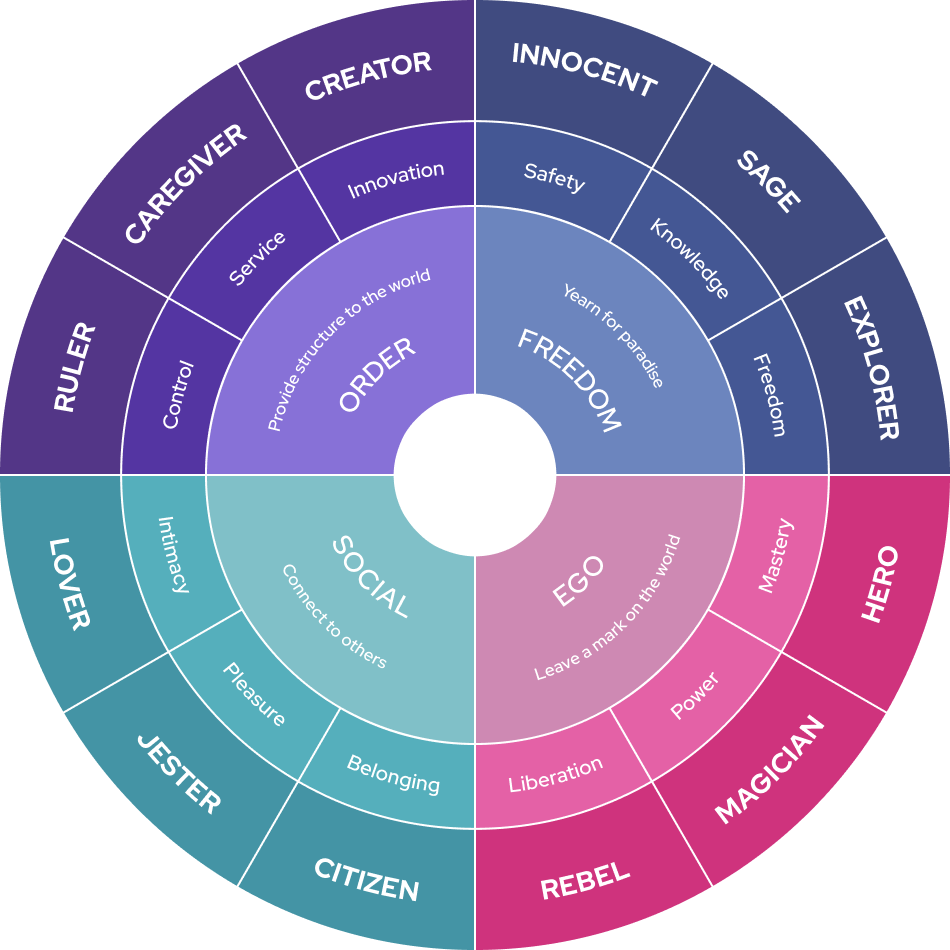
1. The Innocent
The Innocent leads with goodness. No edge, no darkness, no complexity — just the genuine belief that simple and pure is enough.
Dove didn’t build one of the most recognized brand platforms in history by being clever or disruptive. They did it by saying: real is good, simple is beautiful, you don’t need to be fixed. Aveeno. Coca-Cola’s nostalgia campaigns. Brands that make you feel like everything’s actually going to be okay.
The Innocent works when the promise is comfort and the audience is exhausted from being told they need to be better. It struggles in crowded markets where “nice” doesn’t cut through.
2. The Explorer
The Explorer exists to push past the edge of what’s comfortable. It doesn’t sell products — it sells identity.
The identity of someone who chooses experience over security. Discovery over routine.
Patagonia isn’t selling a jacket. They’re selling the version of you who would rather be cold and alive than warm and bored. Jeep does the same thing with four wheels and a lot of mud.
If your brand is built around the idea that your audience is meant for MORE than the default? The Explorer archetype is worth a serious look.
3. The Sage
The Sage believes that the right information changes everything. Its job is to know things deeply — and share that knowledge in a way that transforms how the audience sees the world.
Google. TED. National Geographic. These aren’t brands that sell — they’re brands that teach. And they earn trust by being right.
The Sage is one of the most powerful archetypes for service businesses where expertise IS the product. But here’s the trap: the Sage has to lead with empathy BEFORE expertise. The moment it tips into “let me explain what you don’t understand,” it loses the audience it came to help.
4. The Hero
The Hero is defined by what it overcomes. It doesn’t avoid difficulty — it moves toward it. And it invites the audience to do the same.
Nike doesn’t sell shoes. They sell the moment you decide not to quit. FedEx built an entire brand promise around reliability under impossible pressure. The Hero says: you’re capable of more than you think — let’s prove it.
The risk? Credibility. If the brand can’t deliver the transformation it promises, the whole thing collapses — fast.
5. The Rebel
The Rebel doesn’t just disagree with the status quo.
It actively works to dismantle it.
Harley-Davidson built a global subculture around the idea that real freedom looks nothing like corporate America. Virgin built a hospitality empire on the premise that the big players were getting away with mediocrity because nobody was willing to call it out directly.
I’ll be honest — this one has some of MY energy.
Studiolit exists because I genuinely believe the “good enough for a small business” mentality is a lie that keeps talented people invisible. That’s a Rebel instinct.
The key is that the Rebel has to stand FOR something, not just against things. Rebellion without a real alternative is just noise.
6. The Magician
The Magician holds the space between what IS and what COULD BE — and makes the crossing feel inevitable.
Apple hasn’t sold hardware in decades. They sell transformation. The promise isn’t “faster processor” — it’s “your life, better.” Disney does this across every touchpoint. Dyson does it in home appliances, which is not an obvious category for magic, but they’ve pulled it off by making every product feel like a revelation.
If the actual product of your work is transformation — if clients come to you one way and leave fundamentally different — the Magician might be closer to your truth than you think.
7. The Everyman
The Everyman doesn’t want to be aspirational. It wants to be real.
It speaks to the audience as a peer. Not impressive, not exclusive — just genuinely, reliably there. Target built a brand on the premise that style shouldn’t require wealth. IKEA made the Everyman a global identity around good design belonging to everyone.
The trap: “we’re just like you” is only compelling if the brand has a real point of view on what kind of person it’s like. Vagueness doesn’t read as relatable. It reads as generic.
8. The Lover
The Lover creates intensity. It’s not just about romance — it’s about the experience of wanting something deeply and having it.
Chanel doesn’t sell perfume. They sell the feeling of being someone who wears Chanel. Godiva doesn’t sell chocolate. They sell the specific pleasure of choosing something for yourself, without apology.
This archetype lives or dies by execution. Taste isn’t optional here. The distance between a Lover brand and a generic “luxury” brand is entirely in the details.
9. The Jester
The Jester makes people laugh — but with a point.
Old Spice took a dying legacy brand and completely rebuilt its identity around absurdist humor. Dollar Shave Club disrupted a commodity category on the back of ONE video that made the audience feel like they were in on a joke the big brands didn’t get.
The risk is real: humor that doesn’t land doesn’t just fail — it damages trust. The Jester requires genuine wit. Attempted humor from a brand with no comedic instinct is worse than silence.
10. The Caregiver
The Caregiver protects. Serves. Shows up.
It doesn’t lead with credentials. It leads with warmth — and earns trust by being consistent, keeping small promises reliably, caring visibly without being asked to.
Johnson & Johnson. Pampers. TOMS.
The emotional promise is simple: we will take care of what matters to you.
The Caregiver’s most powerful move isn’t a campaign. It’s showing up the same way every single time until trust is the only reasonable response.
The trap: a Caregiver that won’t deliver hard truths loses credibility. Warmth without honesty isn’t care. It’s avoidance.
11. The Creator
The Creator is compelled to make things that didn’t exist before.
Strong aesthetic opinions. Deep investment in craft. The belief that HOW something is made is as important as what it is. Lego’s entire premise is that building something yourself has more value than consuming something pre-made. Adobe has made Creator values central to its own brand. Crayola has been selling the permission to make things for over a century.
I’ll be honest — this one is close to home. The Creator runs as a secondary voice in everything I build at Studiolit. The Rebel leads, but the Creator is always underneath, obsessing over the decisions most people don’t notice.
12. The Ruler
The Ruler doesn’t position itself as an option.
It positions itself as the standard.
Rolex. Mercedes-Benz. Microsoft. These brands don’t compete — they define the category and let everything else position itself relative to them.
The risk is that authority without warmth reads as arrogance. The Ruler brands that endure have genuine substance behind the positioning — not just premium pricing and a serious logo.
What Archetypes Look Like in Real Client Work
Knowing the 12 archetypes is useful.
Knowing which one is TRUE for your specific brand — and then building every visual and verbal decision from that foundation?
That’s what actually changes anything.
Let me show you exactly what I mean.
I recently worked with PV Bark, a new enrichment-based dog boarding, daycare, and grooming facility in Prescott Valley. Owner Elaine O’Connor came to me with a logo she loved and a brand that existed entirely in her head.
What she had built was genuinely different from every other facility in the region.
But she couldn’t fully articulate WHY — and that gap was going to cost her.

We did the Brand Ignition Workshop — a full excavation of her values, her origin story, what she believed the pet care industry was getting catastrophically wrong, and what she promised every pet parent who walked through her door.
The origin story alone was the whole brand.
In 2021, home renovation work forced Elaine’s family out of their house for nearly a week. Two large dogs. Every facility they’d ever used was full. One told her to call back in 12 weeks. They scrambled, found a last-minute arrangement — and one of their dogs escaped and made her own way home.
That week didn’t just expose a gap in the market. It made it personal.
She had watched dogs come home injured with no explanation. A dog that lost 10 pounds in a single boarding stay. Animals that came back fundamentally changed by an experience their owners knew nothing about — because nobody told them and the dog couldn’t.
THAT story is a Caregiver brand. Every detail of it.
PV Bark’s primary archetype is the Caregiver — built on the premise that when a pet owner trusts you with an animal they love, that trust is sacred. It shows up in every operational decision: standing desks at reception so staff feel present (not barricaded behind a counter), per-dog pricing so no owner faces a surprise charge, a $500 boarding health warranty so the team never hesitates to get a dog the care it needs, proactive communication as a standard so pet parents hear from PV Bark before they think to ask.
But a Caregiver brand without depth is just warmth with no substance.
The supporting archetype is the Sage — the layer that earns long-term trust by teaching. PV Bark doesn’t just send a boarding update that says “your dog is doing great.” They explain that fifteen minutes of good scent work tires a dog more than an hour of running — because the mental need was never being met. That one insight changes how an owner understands their own animal.
That’s the Sage doing exactly what it’s supposed to do.
The visual identity, the voice guidelines, the messaging hierarchy — all of it built from those two archetypes in clear sequence.
Lead with warmth. Back it up with expertise. Never sacrifice one for the other.
PV Bark opened with a complete brand system already working across every touchpoint. Spring break hit and reservations came in at a volume that made clear something was connecting. Word moved through the community the way trust moves — neighbors telling neighbors, people who’d experienced it recommending it without being asked.
Clients stopped calling mid-boarding to check in.
Not because they stopped caring. Because they already expected to hear from PV Bark first.
THAT is what a clear archetype does in practice. It doesn’t just describe how a brand sounds. It determines how every decision gets made — and it keeps making the same promise consistently enough that the audience stops questioning it.
How Do I Find My Brand Archetype?
Here’s the thing…
Most founders already KNOW their archetype. They just haven’t had a framework to name it.
The questions that actually get you there aren’t “pick three words that describe your brand.” They’re harder:
What does your brand stand against? Not what do you offer — what’s the broken version of your category, and why does it genuinely make you angry?
What do you believe about your industry that most of your competitors won’t say out loud?
What’s the real story of why you exist? Not the polished About page version — the moment that made the gap undeniable.
What does a client actually feel when they leave an interaction with you? Not “satisfied.” What’s the specific emotional shift?
The archetype that emerges from honest answers to those questions is the one worth building from.
And it’s almost never the one that sounds most impressive in the abstract.
The Gap Between Knowing and Using
Reading this is the starting point.
The archetype you identified somewhere in this post? That’s useful information.
What you DO with it is the actual work.
The work is systematic application: building a voice that sounds the same across every channel, making visual decisions that reinforce the archetype instead of contradicting it, writing messaging that speaks to the emotional need your archetype is built to meet.
That’s exactly what happens inside Brand Strategy Services. Phase 2 is built entirely around archetype development — identifying your primary and secondary archetypes from your real story, your values, and your client’s actual emotional need. Everything downstream — voice guidelines, messaging hierarchy, visual identity — follows from that foundation.
Want to see what the full process looks like? The PV Bark brand identity case study shows it from Brand Ignition Workshop through launch.
If you finished reading this and immediately recognized your archetype — or immediately recognized that your brand has been trying to be two incompatible things at once — that’s a signal worth paying attention to.
Your brand is already talking.
The question is whether it’s saying the right thing.
What are the 12 brand archetypes?
The 12 brand archetypes are: The Innocent, The Explorer, The Sage, The Hero, The Rebel, The Magician, The Everyman, The Lover, The Jester, The Caregiver, The Creator, and The Ruler. Rooted in Carl Jung’s theory of universal characters, each archetype represents a distinct set of values, motivations, and emotional promises. Most strong brands operate primarily from one archetype, with a secondary that adds dimension.
Can a brand have more than one archetype?
Yes — and most strong brands do. One has to lead; the second adds dimension without creating contradiction. PV Bark is a Caregiver brand first. The Sage is the layer underneath that earns lasting credibility. What doesn’t work: trying to operate from two archetypes that pull in opposite directions, or refusing to commit because you want to appeal to everyone.
How do I find my brand archetype?
Through excavation, not selection. The archetype that’s true for your brand lives in your founding story, your conviction about what your industry gets wrong, and the transformation you actually deliver. Picking one from a list because it sounds right is a starting point at best. Doing the deeper work is what turns an archetype into a real brand system.
Why do brand archetypes matter for small businesses?
Because small businesses can’t afford to be generic. The businesses that get lost in a crowded market aren’t usually bad at what they do — they’re just indistinguishable from everything around them. A clear archetype solves that. It gives the brand a coherent identity that runs through every touchpoint: not just the logo, but the way the phone gets answered and the way a proposal is written. That coherence is often the deciding factor between a business that grows on reputation and one that keeps starting from zero.
What happens when a brand doesn’t have a clear archetype?
The brand feels generic even when the business is excellent. The messaging doesn’t stick. The visuals look like everyone else in the category. And the people who would be a perfect fit don’t recognize themselves in the brand — so they move on without knowing what they missed. It doesn’t announce itself loudly. It just costs you. Consistently. Invisibly. Every single day.

Stephanie Lauderback
Brand Identity Designer & Web Strategist
Stephanie is the founder of Studiolit, a solo branding and web design studio based in Prescott Valley, Arizona. With 15 years of experience working with small businesses on brand identity and web design, she helps founders stop blending in and start showing up as the obvious choice. She also teaches in the design program at Yavapai Community College.
Share this article: